-
Fei-Fei Li, "The Worlds I See"책 읽는 즐거움 2026. 9. 28. 04:29
.
잘 쓴 회고록이다. 내겐 페이지마다가 재밌었다. 이를테면, Fei-Fei Li도 프린스턴대학 시절에 읽은 Schrödinger 의 "What is Life?"에 대해 인상적으로 이야기한다. 읽었거나 읽을 많은 이들에게, 단지 90쪽 본문의 "What is Life?"는, 내게 그렇듯, 가장 특별한 책 중의 하나일 게다.
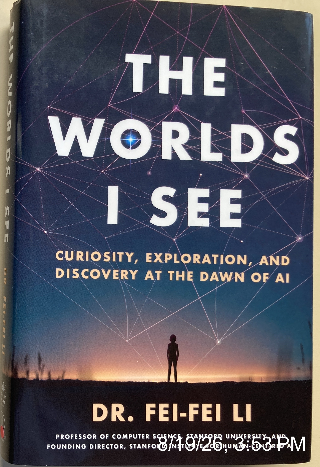
Dr. Fei-Fei Li, "The Worlds I See: Curiosity, Exploration,
and Discovery at the Dawn of AI" (2023)
[비디오] AI book review: The Worlds I See by Dr. Fei-Fei Li
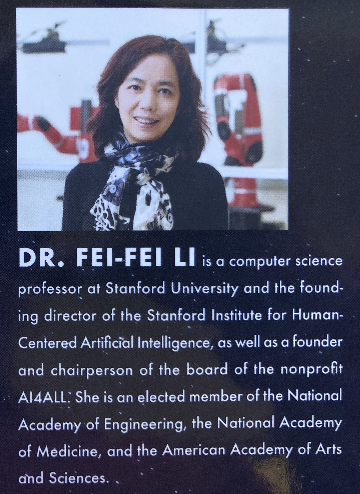
"An inspiring personal journey from immigrant childhood to trailblazing scientist ..." --- Jennifer Doudna, Nobel laureate in Chemistry, CRISPR pioneer, and coauthor of A Crack in Creation
본문에서:
As a lifelong academic on my way to testify before the House Committee on Science, Sapce, and Tchnology on artificial intelligence, I suppose nerves were expected.... It was June 26, 2018, and each passing minute brought me closer to a career first: an appearance at, of all things, a congressional hearing. (p.1)
Much of my written testimony, in fact, was drafted in a cramped chair just outside of her room in the ICU, amidst blur of blue scrubs and white coats.... Disease, however, is no match for the pride of an immigrant mother; the opportunity to see her daughter address the United States Congress, little more than two decades after arriving in this country, was simply too much to pass up. She'd been an unfailing source of support throughout my career, and was, as i should have expected, adamant that I attend. (p. 5)
In physics, I didn't see complexity so much as I saw grandeur. It offered the elegance and certainty of mathematics, the tangibility of chemistry, and, most arresting of all, something I never imagined the sciences could offer: a sense of humanity that felt as poetic as the literature I was raised on.... My love for liturature remained, but physics was now the lense through which I saw the world, everywhere I went.... I loved it with a simple purity. (p. 27-28)
The final months of my [high school] senior year were probably the first time I'd felt anything resembling self-confidence since I'd arrived in America. Mr. Sabella's mentorship helped me rediscover a sense of dignity and reminded me that friendship -- trust -- was possible for outsiders, too. I even got to know his wife, Jean. They were both strikingly tall and taught high school math, but where he was guarded and pensive, she was outgoing and joyously talkative....
As if he knew the thought had crossed my mind, he approached me one day, and uncharacteristically timid.... He was just curious -- you know, if it wasn't too big deal or anything -- did I maybe want to stay in touch with him and his family after the school year ended?
I couldn't help but laugh.... What he clearly hadn't realized is that he'd become my closest, deepest, and, I suppose, only American friend -- and that the Sabellas already felt like my American family. (p. 66-67)
"See, she and I, er, we decided that ..."
"Mr. Sabella, I don't understand what --"
"I'm trying to tell you we're going to lend you the rest of the money you need to buy the dry-cleaning shop!" (p. 82)
Erwin Schrödinger was among my favorite examples. Despite a career spent at the forefront of twentieth-century quantum mechanics, his short but profound What is Life? examined genetics, the behavior of living organisms, and even the ethical implications of their study. The book had a lasting impact on me, and I was captivated by the idea of exploring the world through a more organic lense....
My reading list grew more and more eclectic. I dove into Douglas Hofstadter's Gödel, Escher, Bach: An Eternal Golden Braid, and was swept away by the range and depth of Roger Penrose's The Emperor's New Mind. In the case of both books, it wasn't just the intellectual heft of their ideas that challenged me, but the richness of the connctions between them. They tapped into our millennia-old desire to understand mind -- indeed, to make sense of intelligence itself. (p. 86-87)
The Cambrian explosion, as it's now known, was a furious reshuffling of the evolutionary order.... Some imagine it was triggered by a sudden change in climate, while others have speculated about a historic shift in ocean acidity. Zoologist Andrew Parker saw somrthing different, though, and while many biologists are skeptical about his hypothesis, it has deeply influenced my thinking about AI. It was less an exogenous force than an internal one, according to Parker, who identifies the fuse that ignited the Cambrian explosion as the emergence of a single capability: photosensibility, or the foundation of the modern eye. (p. 100)
The brain, therefore, was not the product of some mysterious intellectual spark from within, but rather a reaction to an ever clearer, ever more chaotic image of the ouside world, reaching inward through the senses. The ability to perceive our surroundings encouraged us to develop a mechanism for integrating, analyzing, and ultimately making sense of that perception. And vision was, by far, its most vibrant constituent. (p. 103)
Minds had no choice but to adapt with greater intellectual capabilities as the scope and reach of vision expanded, gradually incorporating an awareness of causality, the passing of time, and even the effects of manipulating the environment itself. (p. 104)
It soon becomes clear that there's no separating the two; to see is to understand ... (p. 113)
All along, neural networks hadn't needed fancier math and more exotic abstractions. They were simply waiting for a clear picture of the world we expected them to understand. Something they could truly learn from. (p. 200)
Among my favorite achievments of our partnerdhip [through Stanford (Institute) HAI, Human-Centered Artificial Intelligence] is the National Research Cloud, or NRC, a shared AI develpoment platform supported entirely by public funding and resources, rather than by the privat sector. Its goal is to keep AI research within reach for scholars, stat-ups, NGOs, and governments around the world, ensuring that our field isn't forever monopolized by the tech giants, or even universities like ours. (p. 305)
Even after decades steeped in the same tensions as everyone else -- partnership, cultural fault lines, election cycles, and all the rest -- my deepest understanding of this country didn't come from the news, or some polemicist's op-ed, or even a textbook. It came from the previlege of knowing the Sabellas, who so exemplified the humanity that I value most this place. It's a spirit that, to me, still feels distinctly American. (p. 315)
'책 읽는 즐거움' 카테고리의 다른 글
오늘은 또 "The Lives of Margaret Fuller"를 (2) 2026.09.25 Katy Robinson, "A Single Square Picture" (0) 2026.09.22 Susskind & Cabannes, "General Relativity" (0) 2026.09.14 Damon Galgut 소설 "The Promise" (0) 2026.09.01 책을 읽으며 5 (0) 2026.08.18