-
Teju Cole, "Known and Strange Things"책 읽는 즐거움 2025. 10. 23. 01:46
.
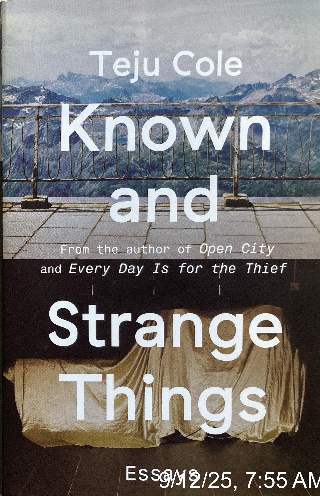
Teju Cole, "Known and Strange Things: Essays" (2016)
나이지리아인 미국 작가/사진작가/art historian Teju Cole(1975-)의 에세이집이다. 에세이 "Tomas Tranströmer"는 읽은 기억이 나서 이 불로그에서 찾아보니 8년 전에 도서관에서 이 책을 빌렸었다. 오십여 편의 에세이 중 그땐 서너 편만 읽고 반납했던 것 같다. (Cf. "Derek Walcott의 시")
책에서
This book contains what I have loved and witnessed, what has seemed right and what has brought joy, what I have been troubled and encourged by, and what has fostered my sense of possiblity and made me feel, as Seamus Heaney wrote, like "a hurry through which known and strange things pass." (xvi, Preface)
There is no world in which I would surrender the intimidating beauty of Yoruba-language poetry for, say, Shakespeare's sonnets. (p. 10)
"For the first four days it rained." Vidia's [Vidia S. Naipaul's] face crinkled with pleasure. "You like that?" "I do, very much. It's simple. It's promising." "I like it, too!" he said. What I had just quoted was the first line of The Enigma of Arrival, his intricate novel about life in rural England.... But it was The Enigma of Arrival, tirelessly intense, its intelligence fastened to the world of humans and of nature, that most influenced my own work, my own ear. I adore, still, its lamguage, its inner music.
For the first four days it rained. I could hardly see where I was. Then it stpped raining and beyond the lawn and outbuildings in front of my cottage i saw fields with stripped trees on the boundaries of each field; and far away, depending on light, glints of a little river, glints which sometimes appeared, oddly, to be above the level of the land
(p. 21)
Tomas Tranströmer has for years now been one of my ports of refuge. The books of his poetry on my shelves never remain unopened for long.... I read Walcott, Bishop, Ondaatje, Symborska, Bonta, and a dozen other marvelous writers, but above all I read Heaney and Tranströmer, who, in different ways, fused the biggest questions with personal experience. (p. 33)
Tranströmer's poems owe something to Japanese tradition, and early in his career he wrote haiku. Reading him, one is also reminded of American poets like Charles Simic (for his surrealism) and Jim Harrison, Gary Snyder, and W. S, Merwin (for their plain speech and koanlike wisdom). But Tranströmer casts a spell all his own, and in factthe strongest associations he brings to my mind are the music of Arvo Pärt and the photography of Saul Leiter. (p. 34)
[ 이 구절에 이어 Teju Cole은 Tranströmer의 시 "Two Cities"에서 (Robert Bly 번역으로) 둘째 연만 인용하는데, 다음은 (Patty Crane 번역으로) 그 전문이다.
Two Cities
Tranströmer
Each on its own side of a strait, two cities
one plunged into darkness, under enemy control.
In the other the lamps are burning.
The luminous shore hypnotizes the blacked-out one.
I swim out in a trnce
on the glittering dark waters.
A muffled tuba-blast breaks in.
It's a friend's voice, take your grave and go.
]
The satisfaction, the pleasure, the comfort one takes in these poems comes from the way they seem to have preexisted us. Or perhaps, to put another way, the magic lies in their ability to present aspects of our selves long buried under manners, culture, and language. (p. 37)
I hadn't known that his somberly beautiful "Irkanda IV" was written after his father's death; now I understand the searching grief of the solo violin.
What I loved most in Sculthorpe's music was the dry yet rich sound of the orchestral pieces and the string quatets, so evocative of the Australian landscape, but I hadn't known that Mahler's work, in particular the final movement of Das Lied von der Erde, had been a vital influence on him. (p. 119)
[ Irkanda IV Das Lied von der Erde Sculthorpe's "Small Town" ]
[Peter Bruegel the Elder's] work was important for the development of imdependent landscapes: landscapes that did not need the pretext of a mythological or biblical event. (p. 225)
[ 아래: Bruegel's "Winter Landscape" ]
Another thing one sees, obscured by distance but vivid up close, is that the Israeli oppression of Palestinian people is not necessarily -- or at least not always -- as crude as Western media can make ti seem. It is in fact extremely refined, and involves a dizzying assems, assemblage of laws and bylaws, contracts, ancient documents, force, amendments, customs, religion, conventions, and sudden irrational moves. all mixed together and imposed with the greast care. (p. 282)
Nothing can justify either anti-Semitism or the raciest persecution of Arabs, and the current use of the law in Israel is a part of the grave ongoing offense to the human dignity of both Palestinians and Jews. (p. 287)

Peter Bruegel the Elder, Winter Landscape with Skaters and a Bird Trap, 1565
'책 읽는 즐거움' 카테고리의 다른 글
John Banville, "The Lock-Up" (0) 2025.11.09 Elizabeth Strout, "Tell Me Everything" (0) 2025.10.31 This Is My Best: Pearl Buck, Erskine Caldwell (2) 2025.09.24 Michael Dine, "This Way To The Universe" (2) 2025.09.20 Naoise Mac Sweeney, "The West" (9) 2025.09.07