-
Nathan Perl-Rosenthal, "The Age of Revolutions"책 읽는 즐거움 2025. 11. 10. 08:35
.
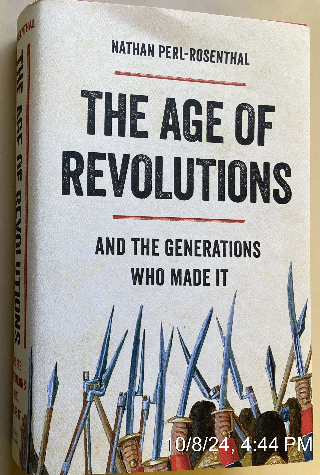
Nathan Perl-Rosenthal, "The Age of Revolutions: And
the Generations Who Made It" (2024)
An Interview with Nathan Perl-Rosenthal
Nathan Perl-Rosenthal (위 인터뷰에서)
I was startled by the similarities that I perceived, for instance, between aspects of the American Revolution and the uprisings in South America in the early 1780s: the central role of creole elites in both, for instance, or the difficulties that patriots faced in surmounting internal divisions. And some of these similarities seemed to extend beyond the Americas, for instance to at least the early stages of the French Revolution.
As my research pushed into the nineteenth century, the chronological divide that I perceived became more and more pronounced. The scale of political organizing changed significantly after 1800, in both Europe and the Americas.... The way that revolutionaries talked about their political projects changed as well. I became convinced that something really fundamental had shifted around 1800. But what? My search for an answer to that question was what brought me to generations.
Generations provides a way of talking about significant changes in culture and political outlook that grounds them in lived experience and material realities.
책 본문에서
On the surface, Haiti and the United States in the 1810s appeared to be opposites. The United States was a larger republic in which slavery was protected and expanding, and in which enslavers held a virtual hammerlock on the hightest national political offices. Haiti was an island nation divided politically between an oligarchical republic in the south and a monarchy in the north. It was ruled by Black people, many of whom had formerly been enslaved themselves; antislavery was its fundamental principle. (p. 385)
The development of illiberal revolution in both countried came to a head in 1820. In the opening months of that year, the US Congress voted in the so-called Missouri Compromise.... The compromise blatantly prioritized national unity and the national political party over the rights of the enslaved and free people of color. (p. 386)
[Thomas Paine] had gained a public following in 1776 with Common Sense, a slashing attack on the British constitutional monarchy, and hereditary monarchy more generally, that led to an impassioned call for North American independence. Between 1790 and 1797, he had published some of his most enduring works: The Rights of Man, which so enraged Edmund Burke; The Age of Reason; and Agarian Justice. (p. 423)
Common Sense spoke to Spanish American authors because it combined an attack on monarchy and advocacy of republicanism with an endorsement of powerful and centralized government. Though often mistaken for a kind of proto-libertarian, Paine was an lifelong advocate for strong government, provided that it was democratic and respnsive to its constituents. (p. 424)
More than sixty years ago, both R. R. Palmer and Eric Hobsbawm offered explanations for the revolutionary era's Janus-faced political transformation. Palmer -- who saw the revolutions as emeging from a three-way confrontation among monarchs, "constitutional bodies," and "democrats" -- interpreted the illiberal outcomes of the revolutionary era as evidence of the resilience of "conservatives" and "established interests" in the face of democrats' push for "equality."... Hobsbawm's explanation was nearly the reverse: the revolutionary era's conservatism came down to the ideology of the French Revolution itself. As a "bourgeois revolution." he argued, it had been fought "against the hierarchical society of noble privilege, but not ... in favour of democratic or egalitarian society."
The argument I have made in this book is that the revolutionary era's illiberalism was neither intrinsic to revolutionary ideology nor external to the revoluitonary movement: it emerged in good measure out of the dynamic of revolutionary political organizing. (p. 448)
Mass political organizing consolidated republican governance in North America and the abolition of slavery in Haiti. It enabled Napoleon to extend many of the legal transformations that had begun in France during the republican decade. But the successful beginning of mass politics had a darker side as well. It quickly became the foundation for modernized form of one-man rule. It also became an instrument of exclusion. (p. 450)
'책 읽는 즐거움' 카테고리의 다른 글
Essays | Tales from the Odyssey (0) 2026.01.04 Amos Oz 소설 "A Perfect Peace" (0) 2025.12.17 John Banville, "The Lock-Up" (0) 2025.11.09 Elizabeth Strout, "Tell Me Everything" (0) 2025.10.31 Teju Cole, "Known and Strange Things" (2) 2025.10.23