-
Karen Amstrong, "A History of God"책 읽는 즐거움 2026. 4. 9. 05:13
.
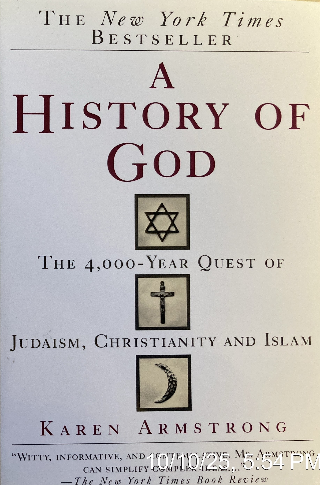
Karen Armstrong, "A History of God: The 4,000-Year Quest of
Judaism, Christianity and Islam' (1993)
이 책에 대해서는, 2년 전 저자의 다른 책 "The Spiral Staircase" (2004)를 읽고서의 포스팅에서, Robert Wright의 "The Evolution of God" (2009)을 읽은 거로 충분하다고 썼었다. 이번에 눈에 띄어 막상 책을 펼쳐보게 되면서는 생각이 바뀌었다. 사실, "The Spiral Staircase"를 한번 잡으면 내려놓기 어려웠던 기억도 한몫했다. 이 책 역시 그랬다. 이런 책들을 쓴, 탁월한, 독립적인 학자로서의 저자를 한층 더 존경하게 된다. 이 책 뒤표지에 인용되어 있는 서평 구절들이 잘 말해준다:
"An admirable and impressible work of synthesis that will give insight and satisfaction to thousands of lay readers." -- The Washington post Book World
"A brilliantly lucid, splendidly readable book. Armstrong has a dazzling ability: she can take a long and complex subject and reduce it to the fundamentals, without ovsimplifying." -- The Sunday Times (London)
"Absorbing... A lode of learning." -- Time
(지금 검색해 보니 번역서로도 로버트 라이트 지음 "신의 진화"와 카렌 암스트롱 지음 "신의 역사"가 나와 있다. 종교인, 특히 신구교 기독교인이나 이슬람교인은 이런 -- 이 비슷한 내용의 -- 책을 한 번은 읽었거나 읽어야 하지 않을까.)
책의 마지막 장 "Does God Have a Future?"에 언급된 신힉자/철학자들 중에는 내 젊은 시절 -- 주로 대학 시절 -- 에 그들의 책을 읽은 이름들이 많아서 반가웠다:
"The Roman Catholic theologian Hans Kung agrees with [the British theologian Louis] Jacobs. preferring a more reasonable explanation for tragedy than the fanciful myth of tsimtsum[(Hebrew) srinking].* He notes that human beings cannot have faith in a weak God but in the living God who made people strong enough to pray in Auschwitz."
(* Self-emptying and self-limiting act of God)
"The Swiss theologian Karl Barth (1886-1968) set his face against the Liberal Protestantism of Schleirmacher, with its emphasis on religious experience. But he was also a leading opponent of natural theology. It was, he thought, a radical error to seek to explain God in rational terms not simply because of the limitations of human mind but also because humanity has been corrupted by the Fall.... The only valid source of God knowledge was the Bible."
"Paul Tillich (1868-1965) was convinced that the personal God of traditional Western theism must go, but he also believed that religion was necessary for human kind.... Tillich agreed with Nietzsche that the personal god was a harmful idea and deserved to die."
"Now the Jesuit Pierre Teilhard de Chardin (1881-1955) combined his belief in God with modern science. He was a paleontologist with a special interest in prehistoric life and drew upon his understanding of evolution to write a new theology. He saw the the whole evolutionary struggle as a devine force which propelled the universe from matter to spirit to personality and finally, beyond personality, to God."
"Martin Buber (1878-1965) had an equally dynamic vision of Judaism as a spiritual process and a striving for elemental unity. Religion consisted entirely of an encounter with a personal God, which nearly always took place in our meetings with other human beings.... Buber had no time for Torah, which he found alienating: God was not a lawgiver! The I-Thou encounter meant freedom and spontaneity, not the weight of a past tradition."
"When John Robinson, Bishop of Woolwich, published Honest to God in 1963, stating that he could no longer subscribe to the old personal God 'out there,' there was uproar in Britain."
본문에서 몇 구절 더:
"Yahweh had finally absorbed his rivals in the religious imagination of Israel; in exile, the lure of paganism had lost its attraction and the religion of Judaism had been born. At a time when the cult of Yahweh might reasonably have been expected to perish, he became the means that enabled people to find hope in impossible circumstances." (p. 61)
"The religion of al-Lah introduced the compassionate ethos which was the hallmark of the more advanced religions: brotherhood and social justice were its crucial virtues. A strong egalitarianism would continue to characterize the Islamic ideal." (p. 157)
"Instead of allowing their so-called deviants to go private, Western Christians simply persecuted them and attempted to wipe out nonconformists. In Islamdom, esoteric thinkers usually died in their beds." (p. 176)
"Like Descartes, Newton had no time for mystery, which he equated with ignorance and superstition. He was anxious to purge Christianity of the miraculous, even if that brought him into conflict with such crucial doctrines as the divinity of Christ. During the 1670s he began a serious theological study of the doctrine of the Trinity and came to the conclusion that it had been foisted on the Church by Athanasius in a specious bid for pagan converts. Arius had been right." (p. 305)
Armstrong은 Thomas Hardy의 시 "The Darkling Thrush" (December 30, 1900)를 인용하는 것으로 책을 맺는다.
'책 읽는 즐거움' 카테고리의 다른 글
책을 읽으며 (4) (0) 2026.04.18 책을 읽으며 (3) (0) 2026.04.18 책을 읽으며 (2) (0) 2026.03.27 책을 읽으며 (1) (0) 2026.03.24 Thornton Wilder 소설 "The Eighth Day" (0) 2026.03.19