-
Colum McCann, 소설 "A Peirogon"책 읽는 즐거움 2026. 4. 20. 00:25
.
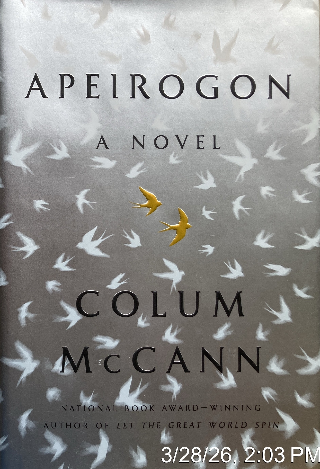
Colum McCann, "A Peirogon" (2020)
저 표지 사진이 무한각형(peirogon)의 한 작은 부분을 보고 있는 느낌을 주는데, 이 소설도 수많은(1001개의) 반짝이는(꽤 자주 한 줄짜리) 조각들로 이루어져 있다.
아래는 책 겉표지 안쪽에서
Bassam Aramin is Palestinian, Rami Elhanan is Israeli. They inhabit a world of conflict that colors every aspect of their daily lives, from the roads they are allowed to drive on, to the schools their daughters, Abir and Smadar, each attend, to the checkpoints, both physical and emotional, they must negotiate.
Their worlds shift irreparably after ten-year-old Abir is killed by a rubber bullet and thirteen-year-old Smadar becomes the victim of suicide bombers. When Bassam and Rami learn of each other's stories, they recognize the loss that connects them and they attempt to use their grief as a weapon for peace.
[위에 쓰인 것은 다 실제 이야기다.]
아래는 책 본문에서 (각각 Rami Elhanan의 장인 Matti Pelod와 부인 Nuri Peolod-Elhanan에 관한 부분 조금씩은, 앞에, "책을 읽으며 (3)"과 "책을 읽으며 (4)"에 따로 인용했다)
(Area C, the largest of the areas, containing most of the West Bank's natural resources, controlled by Israel, with the Palestinian Authority responsible for providing education and medical services to Palestinians only, with Israel providing exclusively for the security and administration of the settler population in over one hundred illegal settlements, with ninety-nine percent of the area being heavily restricted or off-limits for construction or development to Palestinian residents, it being almost impossible to secure a permit for any building or water project.) (p. 30)
Israeli Defense Force Order 101, Regarding Prohibition of Incitement and Hostile Propaganda Actions, was put into effect in 1967. It forbade Palestinians to use the word Palestine in official documents, to depict or raise or fly their flag, or to make any sort of art that combinded the colors of the traditional flag. (p. 179)
My name is Rami Elhanan. I am the father of Smadar. I am a sixty-seven-year-old graphic designer, an Israeli, a Jew, a seventh-generation Jerusalemite. Also what you might call a graduate of the Holocaust.
( ... )
I didn't think about them .... The Palestinians in Jerusalem, well they mowed the lawns, they collected the garbage, they built the houses, cleared the plates from the table.... That was the old joke: every town needed at least one good Arab, how else could you get the fridge fixed on Saturday? And if they were ever anything other than objects, they were objects to be feared, because, if you didn't fear them then they would become real people. And we didn't want them to be real people, we couldn't handle that.
( ... )
It may sound strange but in Israel we don't really know what the Occupation actually is. We sit in our coffee shop and we have a good time and we don't have to deal with it. We have no idea what it's like to walk through a checkpoint every day. Or to have our family land taken away. Or to wake up with a gun in our faces. We have two sets of laws, two sets of roads, two sets of values. To most Israelis this seems impossible, some sort of weird distortion of reality, but it is not. Because we just don't know.... We have no access to what it's like for people in the West Bank or Gaza. Nobody talks aboit it. You're not allowed into Bethlehem unless you're a soldier. We drive on our Israeli-only roads. We bypass the Arab villages....
Truth is, you can't have a humane occupation. It doesn't exist. It can't. It's about control.
( ... )
We must end the Occupation and then sit down together to figure it out. One state, two states, it doesn't matter at this stage -- just end the Occupation, and then begin the process of rebuilding the possibility of dignity for all of us.... Being Jewish means that you respect justice and fairness. No people can rule another people and obtain security or peace for themselves. The Occupation is neither just nor sustainable. And being against the Occupation is, in no way, a form of anti-Semitism. (pp. 217-226)
It is tradition in both Israel and Palestein -- harchnasset orchim in Hebrew, marhabaan fi algharib in Arabic -- to give gifts of fresh bread and sea salt to newly arrived strangers. (p. 294)
The presence of natsch [natsch thistle] on a plot of land is sometimes thought of as a sign that the soil is not being tilled or used properly.
In Israeli courts, under an interpretation of the Ottoman land law of 1858, the existence of the thistle in rural areas is often used as an argument that the land is not being cultivated and therefore can be declared state land and turned over to settlers. (p. 392)
Women in Black, an Israeli human rights group, was founded in Jerusalem in 1988 ... following the outbreak of the First Intifada. The women stood at intersections and traffic lights and in central squares, wearing dark clothing head to toe, carrying black signs with image of a white band and lettering: Stop the Occupation.
'책 읽는 즐거움' 카테고리의 다른 글
Cade Metz, "Genius Makers" (0) 2026.05.04 Eudora Welty, "The Optimist's Daughter" (0) 2026.04.26 책을 읽으며 (4) (0) 2026.04.18 책을 읽으며 (3) (0) 2026.04.18 Karen Amstrong, "A History of God" (0) 2026.04.09