-
A. H. Koblitz, "A Convergence of Lives: Sofia Kovalevskaia"책 읽는 즐거움 2026. 6. 20. 07:38
.
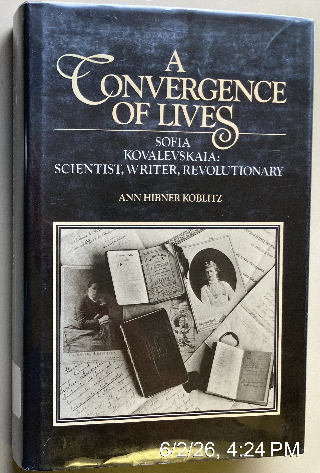
A. H. Koblitz, "A Convergence of Lives: Sofia Kovalevskaia:
Scientist, Writer, Revolutionary" (1983)
Kovalevskaia’s work deserves to stand on its own merits, and has no need of such hyperbole. She published ten papers, of which the most significant are probably the proof of the Cauchy-Kowalevski theorem and her proof of integrability for a kind of rigid body motion that included the asymmetrical top. Her work on the latter was particularly ingenious. She faced a considerable number of obstacles and more than her share of detractors. It is worth noting that few of the many barriers she encountered came from mathematicians. In particular, Weierstrass, Mittag-Leffler, Hermite and Königsberger were all strong advocates and, when they needed to be, defenders. ---- 위 서평에서.
본문에서
On July 21, 1882, Kovalevskaia was chosen a member of the Paris Mathematical Society. She got to know several of the best French specialists: Charles Hermite, Henri Poincaré, Emile Picard, Gaston Darboux and others, all of whom were helpful methematically. (p. 162)
In fact, mathematicians did not become generally aware of Cauchy's work on the question [of the existence and uniqueness of the solution of a given PDE] until 1875, when the Frenchman Gaston Darboux published a paper more or less duplicating Kovalevskaia's results. In the ensuing priority dispute, waged by Weierstrass on Kovalevskaia's behalf and by Hermite on Darvoux's behalf, Cauchy's solution was uncovered.
Kovalevskaia's results and the simplicity of her exposition was greatly admired by specialists at the time. The French mathematician Henri Poincaré, for example, was impressed by the elegance of Sofia's paper. In his famous memoir on the three body problem, he wrote: "Madame Kovalevsky significantly simplified Cauchy's method of proof, and gave the theorem its final form." .... (p. 240)
The other theme of Kovalevskaia's most important research concerned the classic problem of the revolution of a solid body about a fixed point. ... What amazed Kovalevskaia's contemporaries most about her solution was their simplicity and elegance. Her reasoning was so clear, her grasp of abelian functions so complete, that the steps of her argument flow one from the other with ease. The Russian specialist in mechanics N. E. Zhukovskii remarked: "The anaysis she uses is so simple that, in my opinion, it would be worthwhile to include it in analytic mechanics courses." (p. 242)
All of Kovalevskaia's novellas, plays, and essays contributed to her posthumous reputation as a writer. But by far the most popular and enduring of her works is thre lyrical, evocative, beautifully written Memories of Childhood (1888-89). (p. 265)
[만난 적도 없고 모르는, 절박한 처지의 러시아 여성 Liubov Murakhina에게서, 1889년 여름, 조언을 청하는 편지를 받고] In spite of her preoccupation with Maksim and her activities in French society, she [Kovalevskaia] was concerned enough to help Liubov. She induced her publishing acquaintances in Moscow to employ Murakhina as a translater, and told her to visit a friend of Kovalevskaia there for further assistance. Her letter to Liubov was so decisive and practical and at the same time so sincerely sympathetic to the unfortunate woman's suffering, that Liubov was almost pathetically grateful. "I am especially happy." she wrote to Kovalevskaia, "because this time I was not mistaken. I assumed that awoman who has devoted herself entirely to the service of science -- has achieved such brilliant results -- ought to be a true human being as well." (p. 274-275, the last page of the book)

사진: 책에서
'책 읽는 즐거움' 카테고리의 다른 글
Ian McEwan, "What We Can Know" (0) 2026.06.12 Thomas Hardy, "Jude the Obscure" (0) 2026.05.21 Cade Metz, "Genius Makers" (0) 2026.05.04 Eudora Welty, "The Optimist's Daughter" (0) 2026.04.26 Colum McCann, 소설 "A Peirogon" (0) 2026.04.20