-
Ian Buruma, "Year Zero"책 읽는 즐거움 2026. 6. 28. 07:57
.
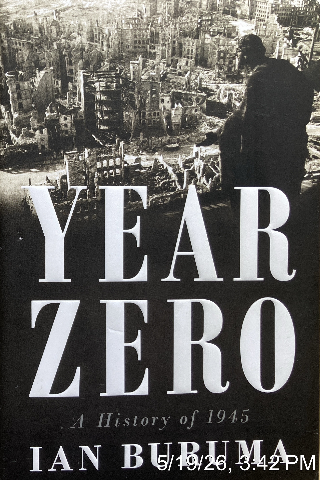
Ian Buruma, "Year Zero: A History of 1945" (2013)
책을 읽고 나니, 제2차 세계 대전 종전 후 '해방'된 나라에서 일어난 일들은 어디서나 크게 다르지 않았다는 것, 그리고 독일의 점령으로부터 연합국에 의해 해방된 프랑스는 베트남과 알제리를 계속 식민지로 두려고 몇 년이나 이들의 독립전쟁의 적이었다는 것, 이 두 가지가 우선 떠오른다.
By Adam Hochschild
위 서평에서:
Despite the lofty democratic aura of World War II, Buruma points out that the Allies spent much of the latter half of 1945 reviving colonialism. After Algerian Arabs began an uprising on V-E Day, demanding equal rights, some of the troops the French governor general called in to suppress them included an elite infantry regiment that had just taken part in the final assault on Germany. Rebellious towns and villages were bombed, or shelled by naval vessels; in two months of fighting as many as 30,000 Algerians may have been killed. Thousands were made to kneel before the French flag and beg forgiveness.
On the other side of the world, inhabitants of the Dutch East Indies demanded freedom just after the Japanese surrender. But the Dutch government answered with troops, aided by soldiers from Britain’s large Indian Army, British battleships and abundant American military supplies. Fighting continued for four years. And in Vietnam, where a crowd of more than 300,000 gathered to hear Ho Chi Minh declare independence from France, the story would of course eventually become even bloodier. In 1945 British troops were crucial to restoring the colonial order in Vietnam, with help from French Foreign Legion detachments. These included many German volunteers, recruited from P.O.W. camps, who had recently been fighting the Allies in Europe or North Africa.
Meanwhile, the victorious Allies were uprooting some 10 million ethnic Germans from parts of Eastern Europe, where they had lived for generations, and forcing them to move to a shrunken Germany, with perhaps a half-million or more dying in the process from hunger, exposure or attacks by vengeful neighbors. Buruma, like others before him, notes the paradox of the Allied armies carrying out something that echoed “Hitler’s project . . . of ethnic purity.”
책 본문에서:
On the morning of August 16, [in Seoul, a Korean resistance hero named Yo Un-hyong, a devout Christian with leftist views and a tast for smart English tweed suits, formed the Committee for the Preparation of Korean Independence with other patriots, including communists just released from Japanese jails. His speech, to thousands of people gathered in a high school playground, was remarkable for two reasons. One was its spirit of generosity: "Now that the japanese people are about to part from the korean people, we should let bygones be bygones and put on good terms." And then there was a strong note of optimism: "Let us forget what we suffered in the past, We must buil on this land of ours an idea society, a rational paradise. Let us set aside individual heroism and progress together in an unbreakable union." (p. 263)
North of Seoul ... about a week before the Soviet troops arrived in Pyondyang, an equally venerable left-leaning Christian patriot named Cho Man-sik, known because of his gentle ways and his native Korean garb as the "Korean Gandhi," also prepared for national independence. Like Yo in the south,Cho had many former political prisoners in the Communist Party in his entourage, but not yet dominated by them....
Even though Cho Man-sik and Yo Un-hyong had a common ideal of Korean unity, the left was riven by factions, and communists were ready to grab power where and when they could. When Yo established the Korean People's Republic in Seoul, he faced a challenge from the right as well, in the shape of the Korean Democratic Party, led by landowners and other members of the old elite, many of whom had collaborated with the Japanese. There were also various Korean politicians in exile, in China and the United States, who were far from united. (p. 264)
And so the stage was set for San Francisco, where, on april 27, 1945, the peace-loving world would unite and the UN be transformed from a wartime alliance to a "democratic organization of the world," as Roosevelt liked to say.... Truman declared in a burst of Yankee optimism: "It will be just as easy for a nations to get along in a republic of the world as it is for us to get along in the republic of the United States. (p. 319)
In his dispatches for the New Yorker, E. B. White had put his finger on the main paradox of the [San Francisco] conference. He wrote that "the first stirrings of internationalism seem to tend toward, rather than away from, natinalism." He saw in the national flags, the uniforms, the martial music, the secret meetings, the diplomatic moves, "a denial of the world community." (p.326)
The fearsome explosion of the first atomic bomb in the desert of New Mexico, on July 16, 1945, even prompted a quasi-religious response from Robert Oppenheimer, a leading figure in developing the bomb. he quoted words from the Hindu scripture Bhagavad Gita:
If the radiance of a thousand suns
Were to burst out at once into the sky,
That would be like the splendor of the Mighty One ...
Now, I am become Death, the shatterer of worlds.
Einstein's first words on hearing about the bombing of Hiroshima were more prosaic: "Oh, weh!" (p. 313)
The noble fruit of Elightenment thinking, ... the idea that human rights should benefit not just one community ... but mankind, was seen by Stéphane Hessel and many others as the greatest contribution of the postwar order. Universal human rights were linked to the law, adopted in Nuremberg, on "crimes aginst humanity," which in turn was linked to the concept of genocide, defined in 1944 by the Polish lawye Rapahael Lemkin as "the deliberate and systematic destruction, in whole or in part, of an ethnic, racial, religious, or national group." (p. 322)
And so Year Zero finally came to an end, on a mixed note of gratitude and anxiety. Grateful that a kind of peace had been achieved, in most places, people had been fewer illusions about a glorious future and growing fears about an increasingly divided world. Millions were still too cold and hungry to celebrate the coming new year with semblance of joy. Besides, the news was often grim: food revolts were expected in occupied Germany; acts of terrorism were creating chaos in Palestine; Koreans were furioulsly protesting against their semicolonial status; fighting continued in Indonesia, with British soldiers and Dutch marines, "fully supplied with American equipment," trying to crush the native rebellion. But the sense one gets from the newspapers around the world on the last day of 1945 is that most people were too anxious to get on with their own lives to care much about the global news anymore. During a worldwide war, everywhere matters. In times of peace, people look to home. (p. 330)
'책 읽는 즐거움' 카테고리의 다른 글
Stephen Hawking, "Brief Answers to the Big Questions" (0) 2026.07.05 A. H. Koblitz, "A Convergence of Lives: Sofia Kovalevskaia" (0) 2026.06.20 Ian McEwan, "What We Can Know" (0) 2026.06.12 Thomas Hardy, "Jude the Obscure" (0) 2026.05.21 Cade Metz, "Genius Makers" (0) 2026.05.04